Augusta University

 Stacey Hudson
A successful dental procedure often begins long before a patient takes a seat in the dental chair. For DCG senior Anna Parviainen, providing endodontic care to a patient with intellectual disabilities became a lesson in the power of preparation, patience and teamwork.
Through thoughtful communication with the patient’s mother, guidance from faculty and skills developed throughout dental school, the student discovered that sometimes the most meaningful lessons in dentistry come from the patients who leave the biggest impression.
By Anna Parviainen
I received a referral to treat a patient who had intellectual disabilities and had previously had dental work done under local anesthesia before, but I knew that this would be a new challenge, as the referral was for endodontic treatment of #9. The first thing I did was reach out to the referring provider, who was able to give me a synopsis of the patient’s ability to tolerate dental work. Next, I reached out to the patient’s mother, who is also her legal guardian, and described to her the procedure in detail. The procedure would include an injection of local anesthetic and a lot of loud, unfamiliar noises. The two components that I was most worried about, however, were the rubber dam and her patience, as I knew the root canal would require a significant amount of time in the chair.
I received a referral to treat a patient who had intellectual disabilities and had previously had dental work done under local anesthesia before, but I knew that this would be a new challenge, as the referral was for endodontic treatment of #9. The first thing I did was reach out to the referring provider, who was able to give me a synopsis of the patient’s ability to tolerate dental work. Next, I reached out to the patient’s mother, who is also her legal guardian, and described to her the procedure in detail. The procedure would include an injection of local anesthetic and a lot of loud, unfamiliar noises. The two components that I was most worried about, however, were the rubber dam and her patience, as I knew the root canal would require a significant amount of time in the chair.
At first, her mother wasn’t sure of the patient’s ability to sit still for long, but she said that she could work on the patient’s focus over the coming weeks, and that the patient should be able to tolerate the chair for about two hours. She informed me that the patient would need a morning appointment, as it was closer to the time that she took her medication and her focus would be better.
After securing a morning appointment for my patient, I brushed up on the material presented to us through Dr. Haeberle’s special care class. Thankfully, the material was fresh on my mind as the class is offered in the fall of our senior year here at the Dental College of Georgia. My experience on externship at the James Knighton Clinic in Adel, GA also proved helpful, where we provided care almost exclusively to children. That experience allowed me to practice using voice control, tell-show-do, and positive reinforcement while doing restorations on children as young as five years old.
The afternoon before the appointment, I reached out to the patient’s mother. She informed me that they had been putting together a 300-piece puzzle to work on her attention span, and that evening they would simulate the rubber dam with a washcloth. I went over the patient’s recent medical history to make sure there hadn’t been any changes, answered any last-minute questions, and gave directions to where I would meet them the next morning.
I also contacted my attending, Dr. Franklin Tay, to let him know about my patient’s medical history ahead of time. Thankfully, Dr. Tay had covered me previously in the endo clinic and I’ve had the privilege to work on research projects with him in the past, so we already had a collaborative working relationship, making it easier to talk through her case together.
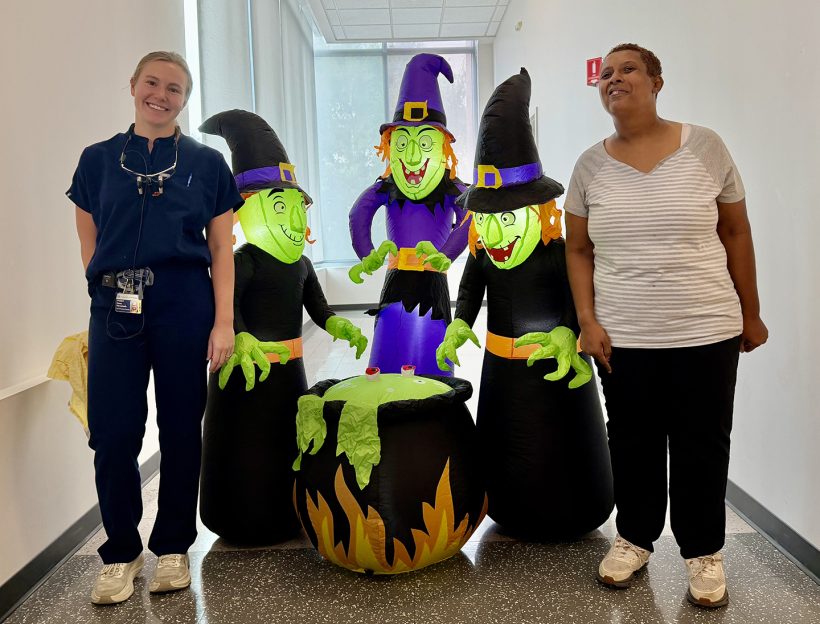
On the morning of the appointment, I finally got the opportunity to meet the patient and her mother face-to-face. I led them back to our operatory and spent a few minutes introducing myself and my assistant, Bella Santana. Bella was fantastic, making sure that the patient and her mother were at ease while I was taking radiographs and completing the diagnostic tests needed. Dr. Tay also came at the beginning of the appointment to introduce himself to the patient and her mother. He put everyone further at ease by assuring us he would be there to back me up every step of the way, and he gave the patient with a sumo wrestler stress ball to squeeze during the appointment. The preparation that the patient’s mother had put in paid off immensely, as the patient tolerated the rubber dam well and cooperated throughout the procedure. I worked as efficiently as possible, and we were able to successfully complete the root canal and walk the patient out (but not before snapping a few photos in front of the Halloween decorations, and not before she tried to wave goodbye to her mother and announced that she was staying with us).
I’m so thankful for the opportunity to work with this patient and the referring doctor to restore her beautiful smile. While I did my part to prepare, this appointment would not have been a success without her mother. The weeks she spent building her daughter’s focus, from the 300-piece puzzle to practicing with a washcloth the night before, made all the difference in the chair. As I get ready to graduate, I know this is one of the patients I’ll remember most. She reminded me why I chose dentistry, and I hope to carry that same patience and preparation into every special care patient I see in the future.