Augusta University
 Stacey Hudson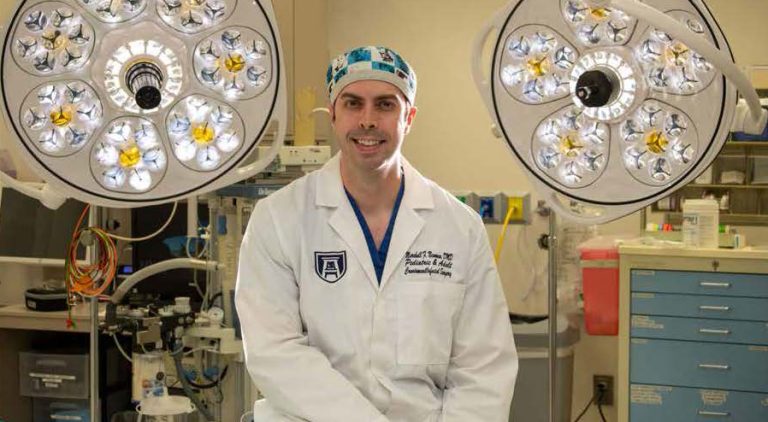
A team at the Dental College of Georgia is advancing a less invasive approach to treating hemimandibular hyperplasia, a rare condition in which one side of the lower jaw grows larger than the other, causing facial asymmetry and difficulty eating.
For patients with the condition, correcting the difference in jaw size can involve complex surgery. Traditional treatment typically requires surgeons to make large cuts in the lower jaw to reposition the bone without the use of guides and sometimes involves significant incisions on the outside of the face.
Dr. Marshall F. Newman, DCG clinical service chief, associate professor and program director of oral and maxillofacial surgery, has pioneered a new way to approach these complex cases. A newly published article describes how the team at DCG is adapting minimally invasive jaw surgery techniques, along with advanced digital technology, to treat a condition that traditionally has required more extensive surgery.
“Our team is using less invasive jaw surgery techniques to treat patients with more complex conditions, including hemimandibular hyperplasia, and other craniofacial differences, and my heart goes out to them. These can be tough surgeries for patients when their conditions are more severe.” Newman said.
The process begins before the patient enters the operating room. Using digital imaging, surgeons create a detailed plan for reshaping the patient’s jaw. That plan is then used to create custom-made titanium cutting guides that fit the patient’s anatomy and help the surgical team determine precisely where bone should be removed.
During surgery, the team uses a small endoscopic camera and specialized ultrasonic instruments to work in a more targeted area rather than large incisions and traditional saws. The goal is to correct the overgrowth while removing less bone and causing less disruption to the surrounding tissues.
For patients, the more conservative approach can have important benefits. Less extensive surgery can mean a shorter recovery while preserving more of the jaw’s natural structure. The approach also leaves more options available if additional treatment is needed later in life.
The minimally invasive techniques and custom guides are designed to reduce the risk of injury to the inferior alveolar nerve, which runs through the lower jaw and provides sensation to the lower lip, chin and lower teeth. Protecting the nerve is an important consideration in jaw surgery because an injury can result in numbness or altered sensation that can be difficult or impossible to correct.
The DCG approach represents a new way of treating this specific type of jaw overgrowth and builds on the DCG’s experience with minimally invasive orthognathic surgery. The combination of new techniques and technologies available across multiple surgical specialties is advancing surgical treatment options for patients with many other types of jaw discrepancies.
The DCG Department of Oral and Maxillofacial Surgery remains committed to not only advancing excellent patient care but training the next generation of dentists. Dr. Mohamad Fawaz, Chief Resident, and Wesley James, DCG Class of 2026 have worked closely with Dr. Newman to provide care for these patients and are co-authors on their recent publication.
Newman’s work reflects a broader effort to make complex jaw surgery more precise while keeping procedures as conservative as possible for patients.
Read the full article, “Management of hemimandibular hyperplasia: A technical note and treatment methodology.”